Flavio Espinoza
In early 2022 I joined Overclock Labs to work on Akash Network -- a decentralized cloud where independent datacenters around the world bid to run your Docker containers instead of you renting a server from one company. It is cheaper than AWS and nobody can deplatform you. It was also the hardest thing I had ever watched a developer try to use: to deploy a single container you wrote a manifest in a YAML dialect almost nobody knew, held the network's token, connected a wallet, signed a transaction, generated and registered an on-chain certificate, waited for providers you had never met to bid, and signed again -- nine steps through a CLI, most of them on a blockchain, before anything ran. That friction is the whole reason the Akash Console exists.
Three of us turned that CLI protocol into a web application a developer could actually finish, and I owned the front end and everything behind it: the React app, the wallet signing, the in-browser certificate crypto, and the mutual-TLS proxy that injected a client certificate into every provider connection and relayed the live streams coming back from a hundred datacenters. I proposed the stack at our first planning meeting (create-react-app, Recoil, Fastify); when Recoil turned out to be incompatible with React 18 I found Jotai and moved on -- fail fast, find a new solution. I also built the four-stage GitHub Actions release pipeline, from auto-versioning to approval-gated deploys, so we could ship continuously.
The work itself was abstraction: turn the pieces of a blockchain protocol into UI steps a human could follow. With no designer, I built the five-step wizard, replaced a blank manifest with editable marketplace templates in a Monaco SDL editor, and turned the chain's three hard prerequisites -- a connected wallet, a minimum balance, a registered certificate -- into a preflight gate of three checkboxes. Behind the one 'Create Certificate' button sat a whole pipeline: generate an X.509 keypair in the browser, encrypt the private key so no secret ever touched a server, and write the public certificate to the chain. One click. That is what I am good at -- taking a difficult problem and finding the creative path through it.
The Architecture
The console is one product with a single job: take a developer from "I have a container" to "it is running on someone's hardware and I can watch it" without making them learn a blockchain. It is a three-tier TypeScript monorepo -- a React web app (create-react-app), a Fastify mutual-TLS proxy, and an API layer -- versioned together and shipped through a four-stage GitHub Actions pipeline (auto-version, multi-arch Docker to GHCR, staging, approval-gated production). The components below are ordered the way a user hits them: the wizard, the SDL editor, the wallet-and-certificate gate, the bid marketplace, and the live monitoring that closes the loop. A sixth section covers the state and delivery architecture underneath all of it.
The Deployment Wizard — The front door. A five-step stepper -- Featured Apps, Select, Configure, Review, Deploy -- that turns "post a workload to a blockchain marketplace" into something a developer can follow without reading the protocol docs.
- A.Built in React (create-react-app) with Material-UI, the wizard is a stepper-driven flow that carries form state across all five steps (Featured Apps -> Select -> Configure -> Review -> Deploy), so a user can move backward and forward without losing input instead of each step being a dead end.
- B.Multi-step form validation with Formik gated progress at each step, so a user could not reach "Deploy" with an invalid SDL or a misconfigured resource request -- the errors surfaced where the mistake was made, not at the end.
- C.A template-driven start: curated, pre-validated SDL configurations (18-plus blockchain node presets -- Validator, RPC, and Sentry nodes among them) pulled via the GitHub API, so the most common deployments started from a working manifest instead of a blank editor.
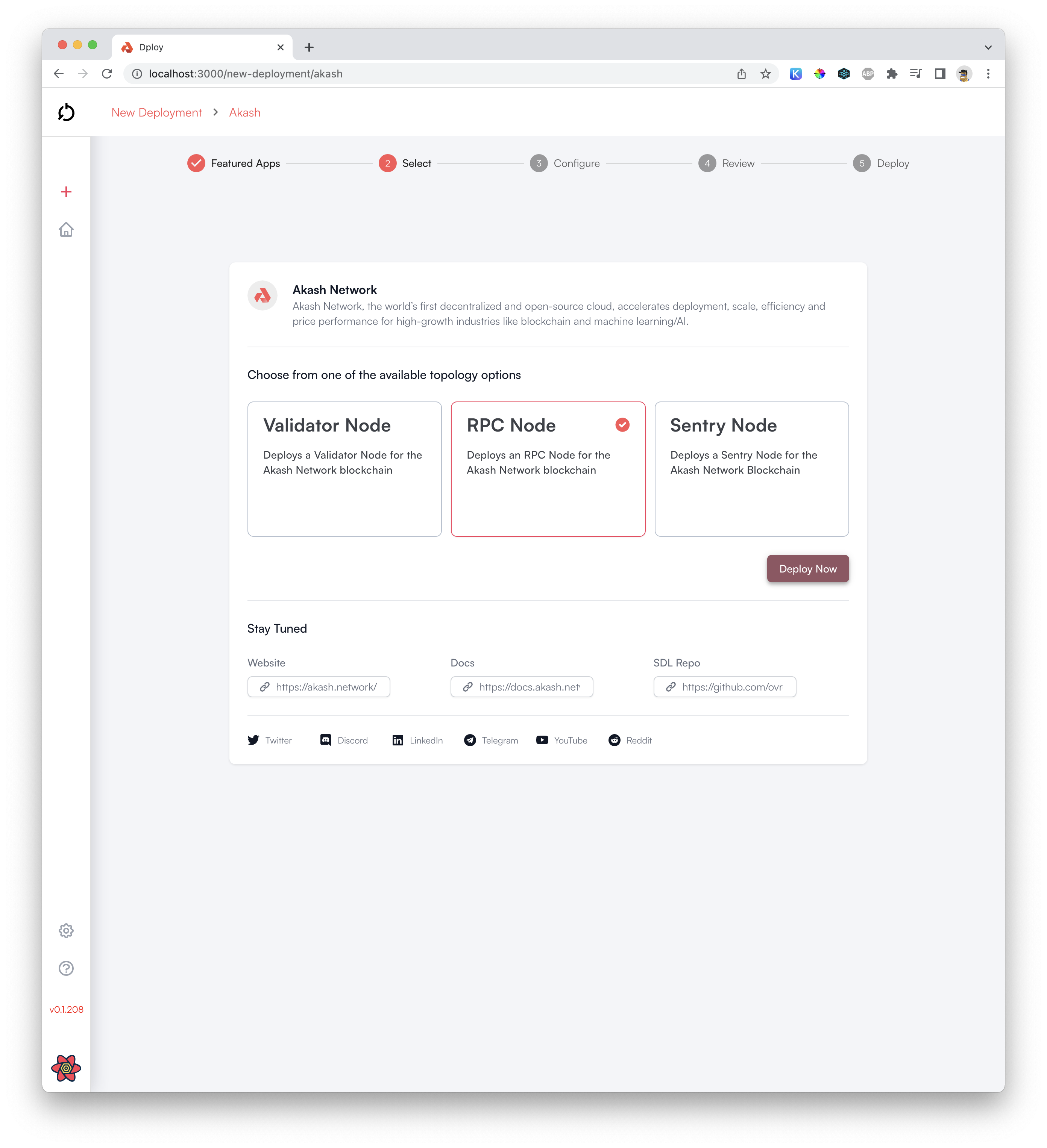
The SDL Editor — For anything beyond a template, the user works with SDL -- Akash's YAML dialect describing the container, resources, and pricing. A blank YAML box is a wall; a real editor with validation is a ramp.
- A.SDL editing runs on Monaco (the engine behind VS Code) with monaco-yaml, wired into the wizard so a user could edit their manifest live during the five-step flow -- real syntax highlighting, inline validation, and autocomplete instead of a plain textarea.
- B.The editor surfaced schema validation as the user typed, with the failure pointing at the offending line -- the same "fail where the mistake is" principle as the wizard, applied to free-form config.
- C.A visual SDL builder sat alongside the raw editor for users who did not want to touch YAML at all, both views driving the same underlying manifest -- part of the editing surface wired into the deployment flow, shipped in the first MVP and the first commercial release.
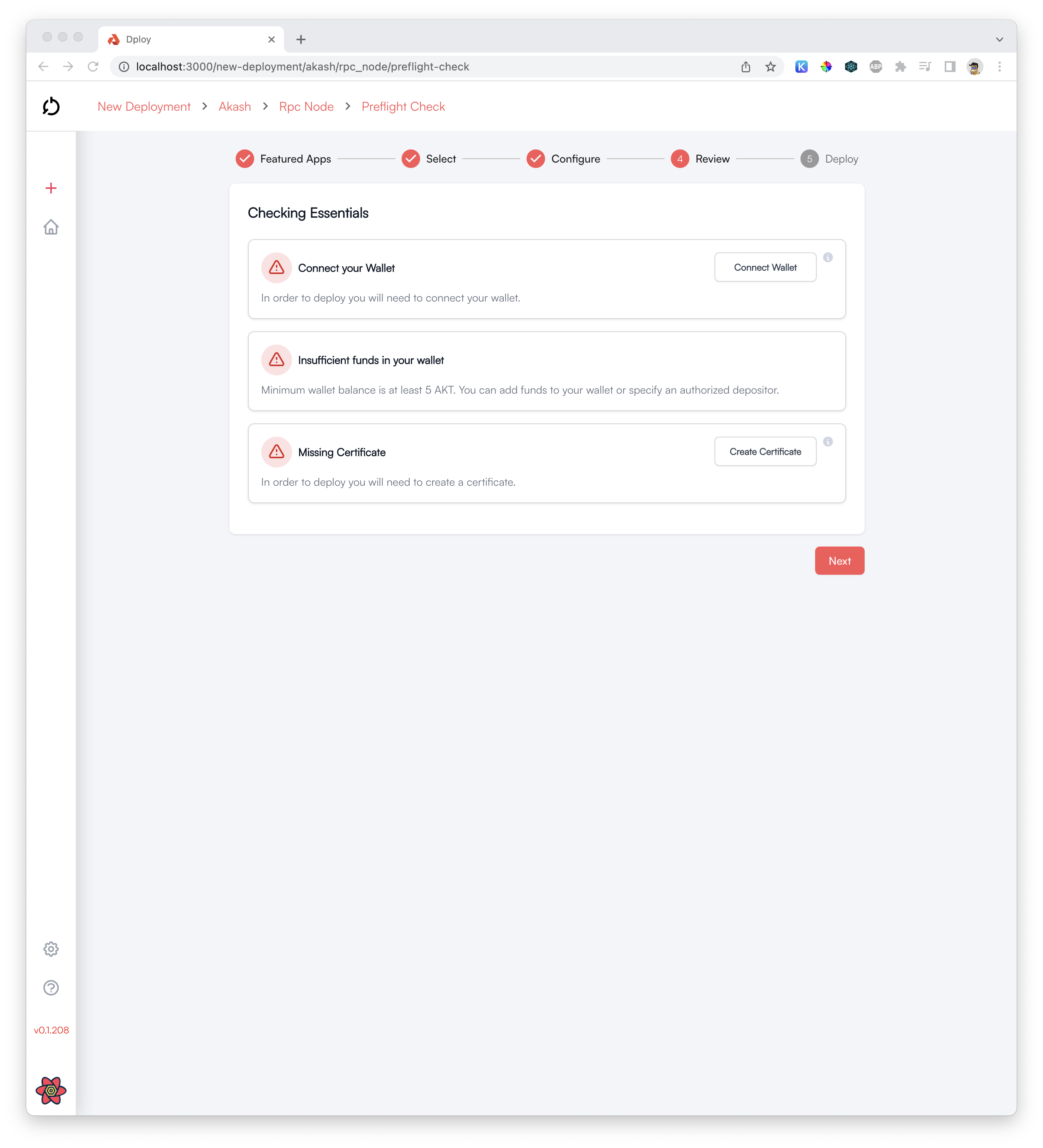
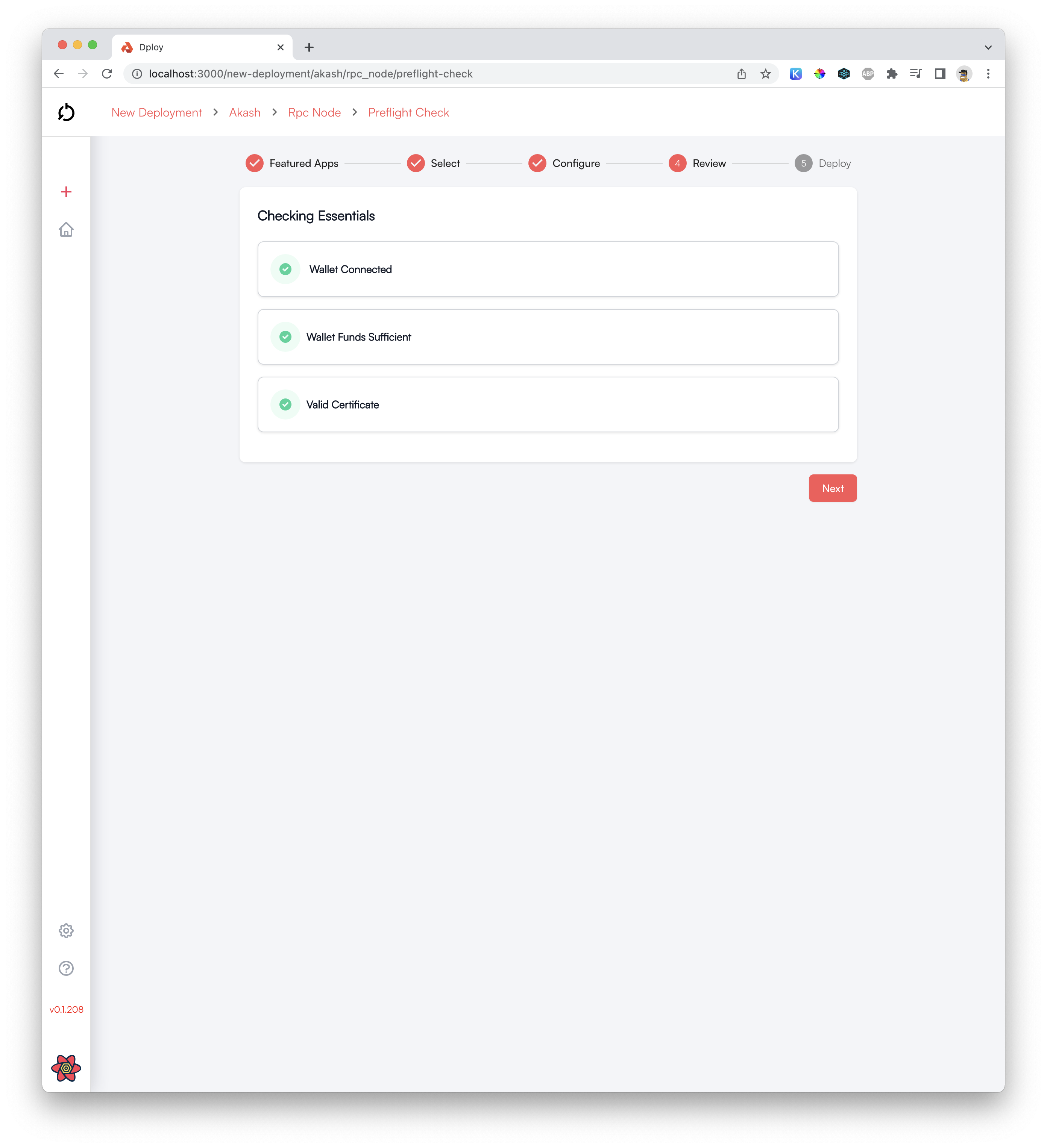
The Preflight Gate -- Wallet and Certificate — Before any deploy, the console verifies the prerequisites the network requires: a connected wallet, a minimum balance (at least 5 AKT), and a valid certificate. Making those explicit and actionable in one place -- so a developer is never guessing why a deploy will not go out -- was a core part of the console's job.
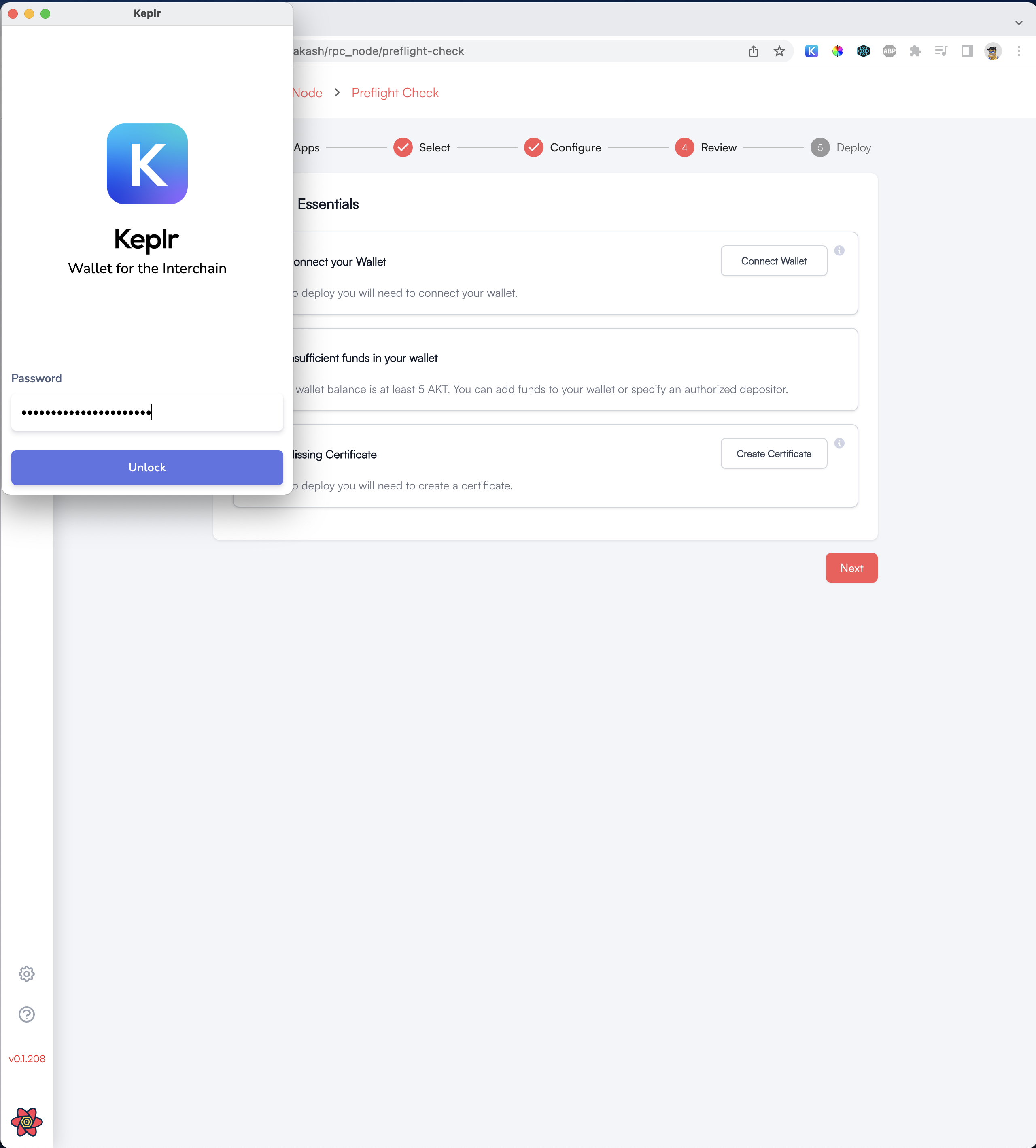
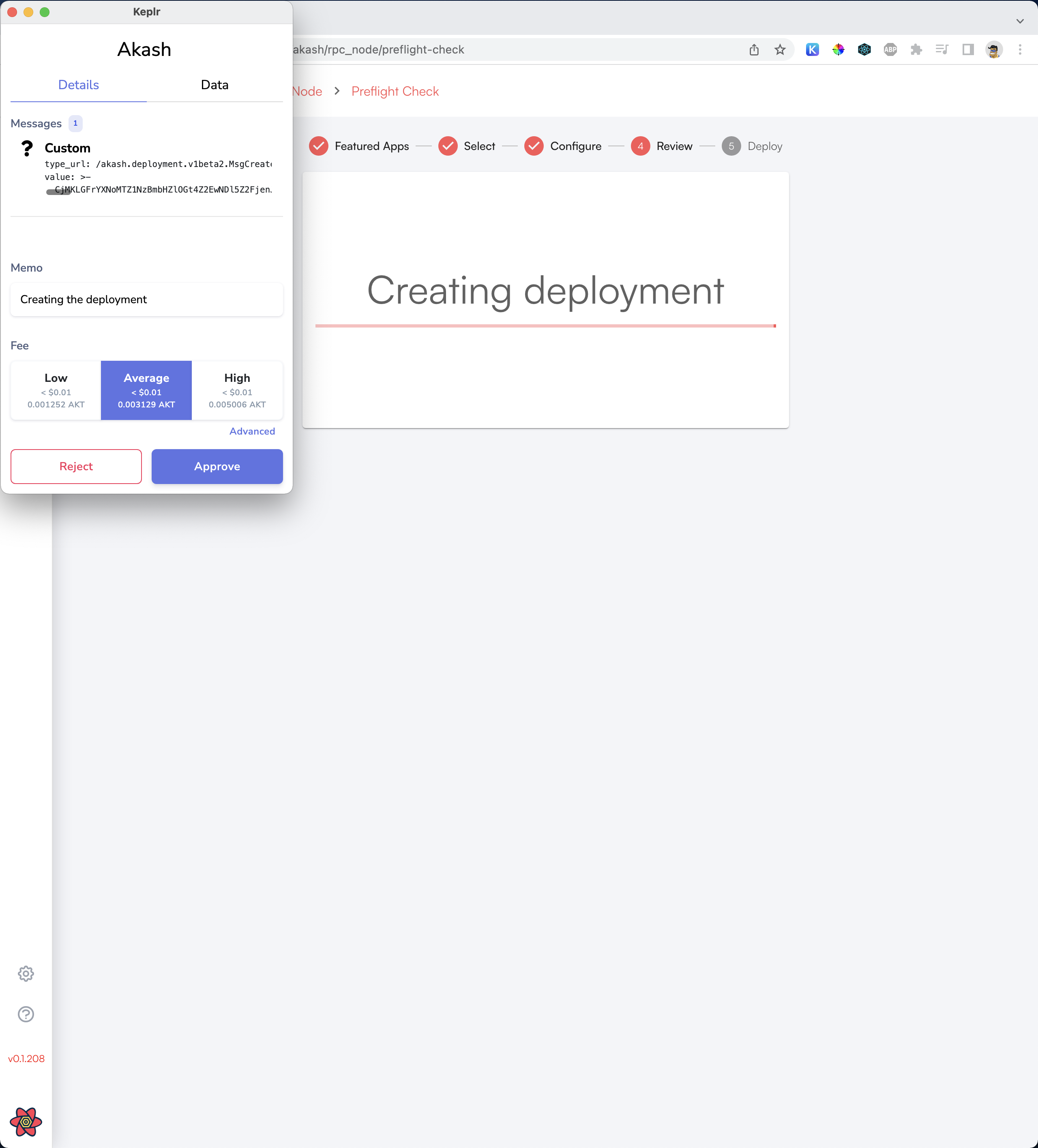
- A.Integrated Keplr (the Cosmos browser wallet) for blockchain auth and transaction signing, using offline signers with amino-json serialization and auto-adjusted gas estimation across the full deployment lifecycle -- create, update, lease, and close. Akash runs on Cosmos, so every signature here is a Cosmos-SDK transaction.
- B.Built the certificate flow end to end: generate an X.509 keypair in the browser, encrypt the private key with AES-256 and keep it in local storage so no secret ever touched a server, and register the public cert on-chain via MsgCreateCertificate so providers could validate the client against the ledger. The "Create Certificate" button in the exhibits is that whole pipeline behind one click.
- C.Surfaced the minimum-balance requirement (at least 5 AKT) in the gate itself, so a newcomer who had not yet funded a wallet saw exactly what was missing instead of hitting a failed deploy.
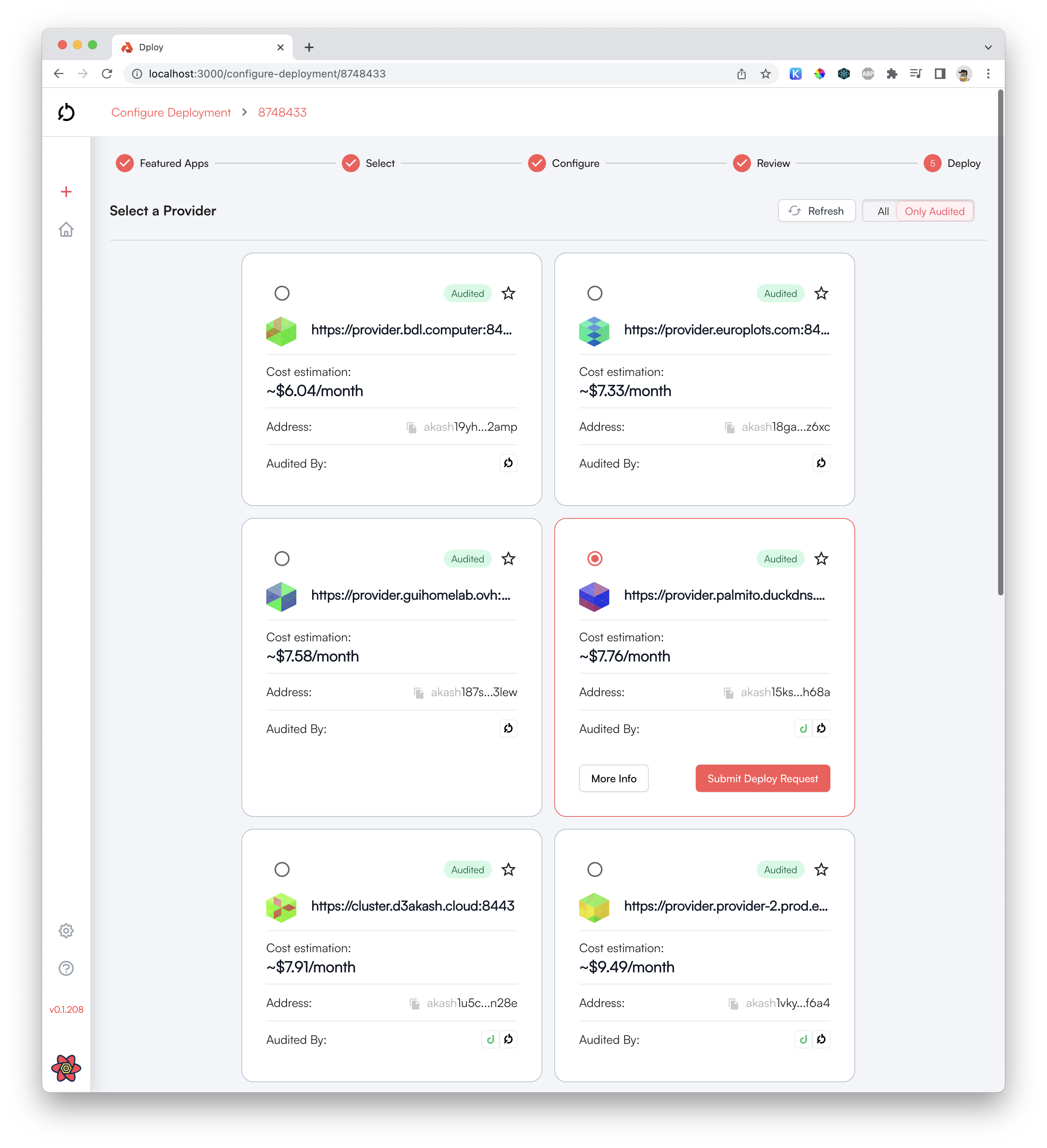
The Provider Marketplace — Once the deployment is posted on-chain, independent providers bid to run it. The marketplace UI is where a user turns a wall of blockchain bids into one informed click.
- A.Rendered live bids from across the provider network, each card showing a monthly cost estimate, the provider's on-chain address, and an audit badge, refreshable in place as new bids arrived.
- B.An "Only Audited" filter let users restrict to vetted providers in one toggle -- a trust shortcut on a marketplace of anonymous datacenters.
- C.Selecting a bid constructed and signed a MsgCreateLease transaction, and the chosen provider then received the manifest over the proxy -- the moment the deployment stops being an order and becomes a running workload.
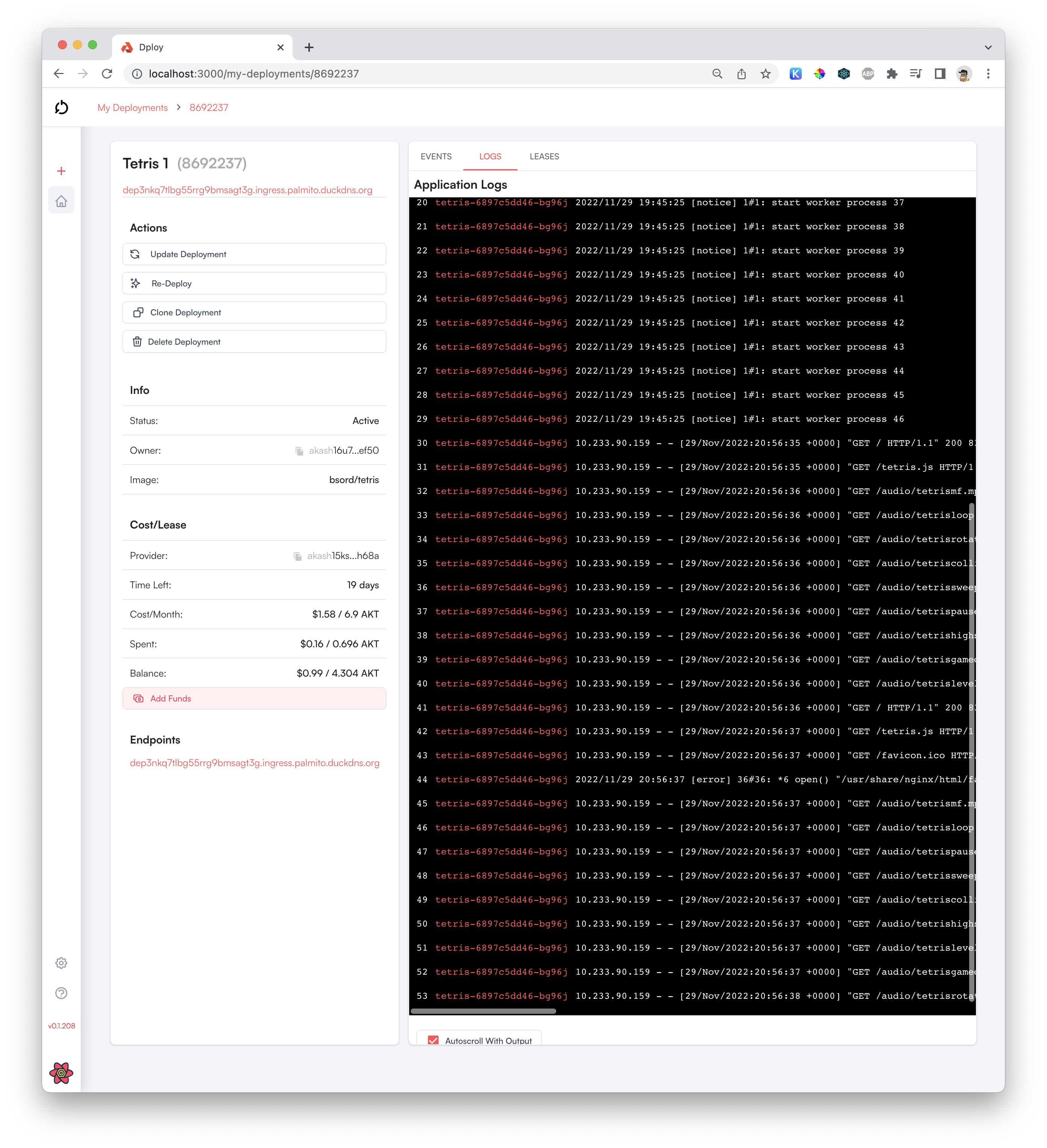
Real-Time Monitoring — Closing the loop. After a lease is live, the user needs to see their app actually running -- logs, events, lease status -- streamed back from a provider's Kubernetes cluster they do not control. This is where the mTLS proxy earns its keep.
- A.Designed a Fastify mutual-TLS proxy gateway that bridged the browser to distributed provider infrastructure: it injected the client certificate into each provider connection and relayed WebSocket streams, so the browser got live data without ever holding the provider's TLS trust directly.
- B.Streamed application logs and Kubernetes events in real time over those WebSocket connections, with throttled rendering and stick-to-bottom autoscroll so a chatty container did not lock up the tab -- continuous-stream UI tuned for the failure mode where data never stops.
- C.Surfaced lease accounting alongside the logs -- cost per month, spent, balance, time remaining -- and an interactive shell (xterm) into the running container, so monitoring, billing, and debugging lived on one screen across 100-plus independent providers.
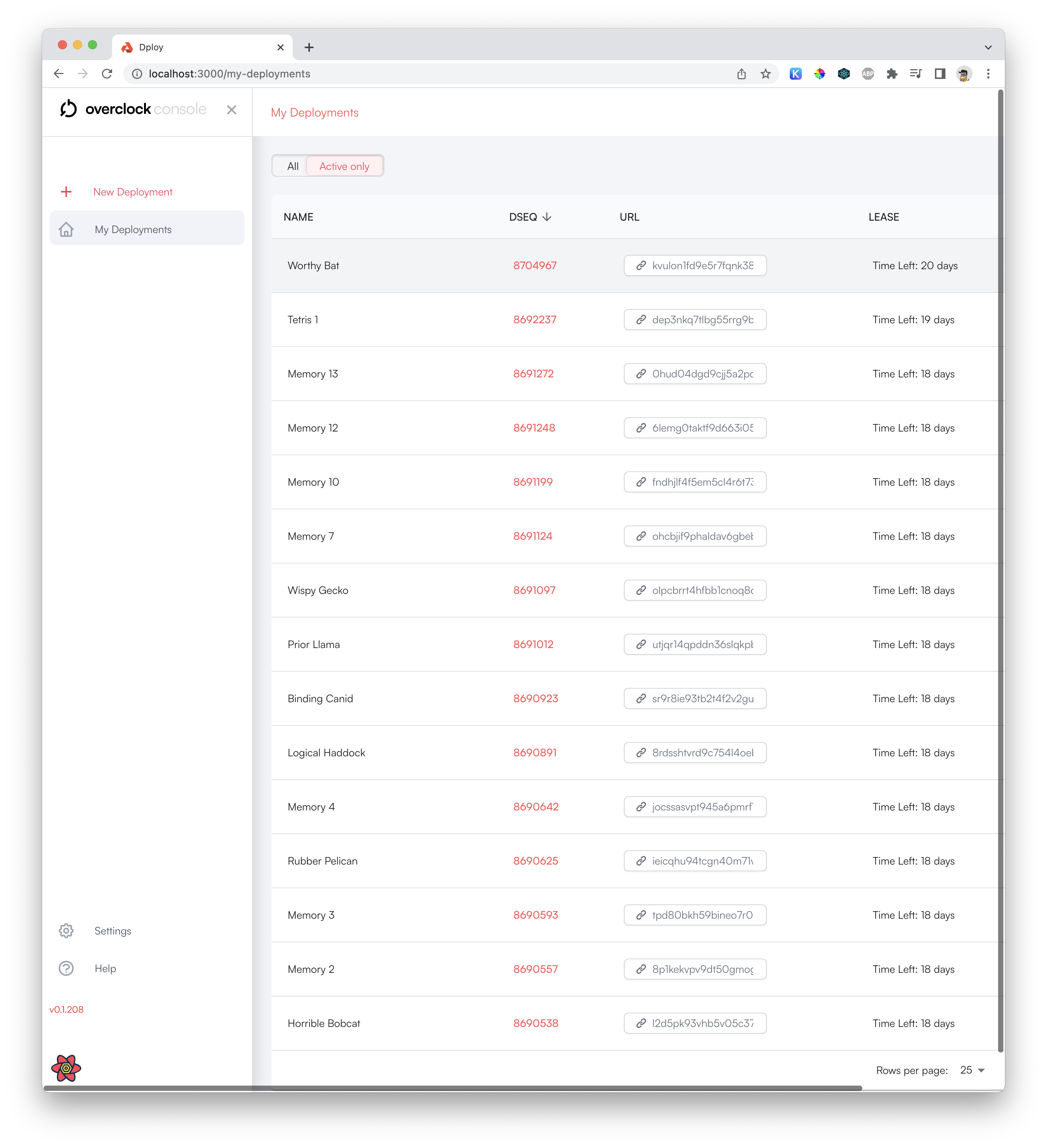
State and Delivery Architecture — The layer under all of it -- how the app held state, and how it got to production.
- A.Atomic state using parameterized atomFamily patterns (Jotai) for per-deployment isolation, so each deployment's state was independent and a change to one lease did not re-render the others -- a deliberate structure that kept the UI fast. (We moved from Recoil to Jotai early when Recoil proved incompatible with the latest React; that story is in the introduction.)
- B.Server state via React Query for the chain and provider reads -- bids, lease status, balances -- so the polling, caching, and refetch logic lived in one disciplined place instead of scattered across components.
- C.A three-tier monorepo (web / Fastify proxy / API) on Yarn workspaces with unified versioning via custom Node scripts, shipped through a four-stage GitHub Actions pipeline: auto-versioning, multi-arch Docker builds to GHCR, staging deploy, and approval-gated production. The console also dogfooded its own product -- deployed onto Akash itself via templated SDL, the platform running on the marketplace it managed.